Lifespan
This is the time.
And this is the record of the time.
"From the Air" Laurie Anderson
Lifespan is a conceptual framework for organizing and understanding the durations and intersections of various entities' existences over time. It focuses on 'spans', the periods between the start and end of something, and how these spans overlap, revealing connections and parallels between different lives, events, and historical moments. By mapping these overlaps, Lifespan aims to create an archive that brings together shared moments and experiences, allowing individuals to see their place in a larger temporal context and potentially generating new spans from these intersections to catalyze the mapping of time.
Time
To explore and map space, you'd use OpenStreetMap. To explore and map knowledge, you'd use Wikipedia. To explore and map time, you'd use Lifespan, if it existed, which it doesn't yet.
Time, space and knowledge are very different kinds of thing to map and explore, but they share some properties. Like space, time is incomprehensibly big, but we only really get to know a tiny part of it. Like knowledge, there are ways to organise and connect time together so it's easier to navigate.
Time directly connects you to everything else that has ever existed and that ever will.
If something is older than you, then there was a point in time when it was your age right now.
If it's younger than you, there was a time when you were the same age it is.
There's something powerful about those overlaps. Find those precise moments, and it's like looking into a mirror.
- Some things exist now, and you are one of them
- Everything that has ever existed has an age
This means you can compare any two things, and find significant points that they have in common.
For example: you, me, Charles Darwin, The Titanic, the BBC website, The London Underground, John Lennon and Wikipedia have all been one year old. We've also all been 12 years, 1 month, 3 weeks, 5 days old, which is the age of Wikipedia as I write this.
You, me, the BBC website, The London Underground and Wikipedia all exist now, and have different ages. But there are dates when all of us - alive or dead today - have been the same age. They're just different dates.
So everything either overlaps in real time, or overlaps at some time.
This is what Lifespan uses to connect things.
The start
The idea is called "Lifespan" because it's all about the periods of time between the starts and ends of things. These are "spans".
Spans are the basic units of Lifespan, just as places and concepts are the basic units of maps and encyclopedias.
Spans have interesting properties that we more or less unconsciously play around with all the time.
The web and the world at large - although showing plenty of interest in time and timelines - seem not to have cottoned onto these properties quite yet.
The key property of spans is that they can overlap.
The end
The ultimate goal of Lifespan is ambitious. It is to give each of us the power to meaningfully archive our lifestories. It is to solve The Archive Problem.
"The Archive Problem" is the one where you literally or metaphorically have a shoebox in the attic - or an attic full of shoeboxes - full of photos and objects that document your past. The problem is being able to get to that stuff, to be able to keep it safe, to be able to use it.
The problem is it's in the attic, or a giant warehouse, or your mind, or someone else's mind, or everyone else's minds.
A bit like all the knowledge that used to be in those sorts of places, but is now available through Wikipedia.
The challenge is to find a way to use a combination of spans and basic human curiosity to build an autocatalytic archive machine.
This will need some explaining.
Spans
The central concept in Lifespan is the "span".
- Spans are periods of time
- Periods of time can overlap
Like this:
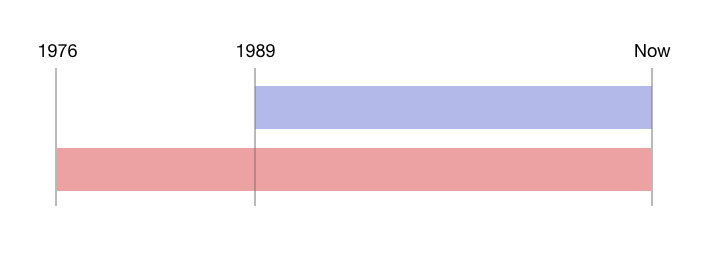
Here, we see two spans. One is me, the other is one of my brothers.
The point is that, with a bit of help, overlaps can generate new spans.
Overlaps
What can we get from this, with no extra input from anyone?
- in 2013, I am 37 years old, Tom is 24
- when Tom was born, I was 13
- when Tom was 13, it was 2002, when I was 26
- when Tom is 26, it will be 2015, when I will be 39
- when I was Tom's age today, it was 2000
- in 2000, Tom was 11
- when I was 11, it was 1987, before Tom was born
- etc.
From these simple calculations, we have generated some dates. Some are within our lives, others are in the future.
The dates we started with were:
- 1976: my year of birth
- 1989: Tom's year of birth
- 2013: now
The dates that have emerged are:
- 2000: when I was the age that Tom is today, when I was him now
This date is like a shadow, because it moves with us. It's today's date minus the difference in our ages.
- 2002: when Tom was the age I was when he was born, when he was me then
This is a fixed moment in time, which we've both now left behind.
There are more dates, but they get painful to think about (1987: when I was the age that Tom was in the year that I was the age that Tom is today).
The thing is, these are meaningful dates, but only to me and Tom. They are the points when we crossed-over each other’s past-selves. When I was him now. When he was me then. If we had side-by-side photos for each of those moments, it would be immediately clear.
The next step is to ask: what was happening at those moments?
In 2000 (when I was him now) I was living in Edinburgh. There are many other things you could say to answer that question, but we'll start there.
The fact that I was in Edinburgh in 2000 is a 1-dimensional answer, just a snapshot in time. It's like saying that someone was alive then, but without knowing how old they are. When were they born, when did they die? When did I start and end my time in Edinburgh? The answer is that I moved there in September 1994, and left in February 2006.
These are new dates: a start and an end. This is a new span.
In 2002 (when he was me then) I was meeting the woman who has become the mother of my children.
This is a new span, and it's still going strong.
The generation of new spans is a way to catalyse the mapping of time.
There are lots of ways to explain the thinking behind Lifespan.
Because of the way time works, it's impossible to get to all those ways at once.
So while you're reading this, you might spend some of the time thinking "alright, but what about... this? Doesn't that mean... that?"
Keep going.
The fundamentals of Lifespan are the starts and ends of things.
Conventional timelines are full of dates, events. This happened here, that happened then.
Lifespan is interested in periods of time - spans - and their overlaps, not just moments in time and their positions.
This is because a magic thing happens when spans overlap: as well as providing a fascinating perspective on things, new spans can be created.
This means that the amount of information in the system can grow.
Spans are everywhere
You'll have noticed that lots of pages on Wikipedia make references to spans:
Charles Robert Darwin, FRS (12 February 1809 – 19 April 1882) was an English naturalist...
..says the page on Charles Darwin.
When you start looking, you see them everywhere (picture of Darwin's blue plaque goes here.)
This is useful...
...but to see what happens next, we need to be able to picture how spans interact.
One way to start describing spans is to start big.
Imagine picking up the entire contents of Wikipedia and taking it back to the very beginning of time.
Dark, isn't it?
Now play time forwards along a vast imaginary x-axis, and position the Wikipedia pages along it as the things in pages come into existence.
The first page you'd put down would probably be The Universe. As you put it down, drag it along behind you to create a line.
Do the same with everything else. A line starts when the thing starts, and ends when it ends.
The Jurassic Period starts when The Universe's line is about 13.5 billion years long, and lasts for 56.3 million years.
By the time you've reached the far end of The Universe's line, which is labelled "now", it's about 13.73 billion years long. As it still exists, the line is still growing, at a rate of one second per second. Phew.
The lines you made are spans. They are lengths of time, with a start and an end.
Sitting here at now, if you turn and look backwards, you'll see scattered behind you a mass of parallel lines, all the spans of all the things, leading away to the beginning of everything.
The earliest spans are on a cosmological scale that utterly dwarfs more recent activity. The most recent cloud, however, is far more detailed and dense, because it corresponds to all of life on Earth, and all of human activity.
If we expanded the set of lines we draw beyond Wikipedia pages, we could add data for all the books, films, radio programmes, tv documentaries, music, web pages, photos, tweets and other things that document all of that human activity in minute detail or are a result of it. That's a lot of stuff, of course.
Now, go to a point somewhere along the x-axis. Go back to the start of something: it can be anything you like, but for now let's choose the start of you. Go back your date of birth.
You've travelled in time to the start of the span that is of most direct significance to you. Now look around.
You will see a vast cloud of other spans. Some are starting just next to you. These are things that are the same age as you now, if they've lasted as long as you have. Some are lines that end at this point. These are things that stopped, and the people who happened to die, just as you were born. The rest (the majority) will be in mid-progress. You can see these as lines that come from the past and continue on towards the present.
Pick one of these lines: the lifespan of someone you know today. A parent, perhaps.
As this was a while ago, you're looking at them when they were younger. This is them when you were born.
Let's look: what's happening in their life?
How old are they? What are they doing? They have just become the parent of you. Where are they?
If you pick up a newspaper (remember, it will be a newspaper whose lifespan intersects with this moment - so not 'The Metro' or 'i') what are the headlines? What's playing on the radio? Who is the Prime Minister?
Lots of questions.
It's February 1976, when I was born.
My mum is 28. She's a nurse at King's College Hospital. She's living in Herne Hill, in London, with my dad, a 28 year old doctor also at King's.
What's going on in the world?
According to Wikipedia, 1976 saw, amongst other things:
- a heat wave in the UK: the hottest average temperature since records began
- The release of Cray-1, the first commercially developed supercomputer
- The first commercial Concorde flight
- Harold Wilson resign as Prime Minister of the United Kingdom, and James Callaghan take his place
- Apple formed by Steve Jobs and Steve Wozniak
- the United States celebrate the 200th anniversary of the Declaration of Independence
- The Great Clock of Westminster (Big Ben) suffer internal damage and stop running for over nine months
- The first known outbreak of Ebola virus, in Yambuku, Zaire
- The space shuttle Enterprise first rolled out of a hangar in California
- The Irish rock band U2 form
- The Intercity 125 High Speed Train introduced
- The Chimpanzee placed on the list of endangered species
- Jimmy Carter defeat incumbent Gerald Ford and become US President
- Hotel California by The Eagles released
- The term "meme" proposed by Richard Dawkins in his book The Selfish Gene
- Etc.
Each of these things is potentially interesting (particularly to those of us born in 1976) and the jumping-off point for some span-based exploration. (If you weren't born in '76, don't worry, you were born in a year, and there's a list for you, too.)
a heat wave in the UK: the hottest average temperature since records began
Records began in 1910. That's a 103 year-old span...
The release of Cray-1, the first commercially developed supercomputer
The Cray in "Cray" was Seymour Cray, born in 1925. So he was 51 when his computer was finally installed.
The first commercial Concorde flight
The Concorde programme began in... the last flight was in...
Harold Wilson resign as Prime Minister of the United Kingdom, and James Callaghan take his place
HW, born died - JC, born died - prime minister, first ongoing...
Apple formed by Steve Jobs and Steve Wozniak
SJ, born died - SW, born ongoing - apple, products, etc.
the United States celebrate the 200th anniversary of the Declaration of Independence
Lifespan of a country...
The Great Clock of Westminster (Big Ben) suffer internal damage and stop running for over nine months
BB, bell made in x by y - building, built in x by y - renamed p in q
The first known outbreak of Ebola virus, in Yambuku, Zaire
Zaire, dates... Ebola...?
The space shuttle Enterprise first rolled out of a hangar in California
Shuttle programme, start end
The Irish rock band U2 form
Names, dates
The Intercity 125 High Speed Train introduced
Dates
The Chimpanzee placed on the list of endangered species
Evolutionary spans... tricky...
Jimmy Carter defeat incumbent Gerald Ford and become US President
JC, dates - GF, dates - presidents, presidency...
Hotel California by The Eagles released
Names, dates
The term "meme" proposed by Richard Dawkins in his book The Selfish Gene
RD, dates...
Just as Wikipedia can take you on a journey through concepts and their relationships, Lifespan can take you on a journey through time.
You can travel in time.